by Travis Williams | May 13, 2022 | Banner Posts
Here’s a review I wrote for an author friend of mine.
Ever leave a review of a book on a website like Amazon or Goodreads?
Authors look forward to getting good reviews from readers and promos from influencers.
Last year I worked on the cover of Nicola MacCameron’s Leoshine: Princess Oracle, Book 1. She’s a friend I met through the Nestbuilders community at Siretona Creative, my publisher.
For the cover, I developed the RAW photo of the painting by Anna Pederson used in the background, and I designed the fantasy font that is used on the cover as well as in a number of places in the manuscript. Finally, I proofread the book.

So there’s a good possibility that I’m biased.
That’s okay. Write what you want when reviewing a book. Here’s the text of the review I posted online for Nicola.
Travis
Leoshine: Princess Oracle, Book 1
Nicola MacCameron
Few books stick with me from the opening scene to the final pages the way Leoshine: Princess Oracle has (her name is pronounced “Leo-sheen”). That’s probably because MacCameron’s words manipulate every sense and emotion. The emotions run high and are just as real as the visuals and smells.
Her rich prose weaves a story that consistently denies any information other than that which the character’s themselves can know. If you’ve been wondering what is meant by the advice to writers, “show don’t tell,” this book is a masterclass in showing without telling.
Every character, and every moment in the book is a study in contrasts. Advanced technology mixes with a something like medieval feudalism. Tenderness and generosity are contrasted against violence and greed. Characters with great philosophical understanding contrast with those having dull incapacity. MacCameron can zoom in on a single drop of sweat or describe vast vistas.
The world building is so complete, the reader is dropped into a far future environment with its own technology, customs, architecture, multiple conlangs, and even an alphabet with its own orthography. Dog ear the map and glossary at the front of the book, you’re going to need it little Tassanara.
It’s science fiction, and while there aren’t any aliens, the humans are all too real—full of fears and angst, anger, vengeance, and love and mercy. If you like your protagonists heroic and your antagonists villainous, remember the old saying, “one man’s terrorist is another man’s freedom fighter.” You think you know who the bad guys are, but don’t ask Leoshine. Perhaps the horse knows. He seems to have figured things out.
And then there’s Iliana, or should I say, ao Kenan Iliana, she whose arrival is greatly anticipated.
MacCameron manages to keep Leoshine’s name on the cover of the book, but she only does so by not introducing Iliana into the story until it’s almost half done.
And it is a show stopper.
Cleopatra’s cinematic entrance into the Roman forum has nothing on Iliana’s arrival. Tens of thousands of soldiers arrayed on their horses welcome her “shuttle.” No spoilers here, but it is one of the most epic depictions of a grand entrance in all of literature.
True to style, in this scene MacCameron contrasts Leoshine’s individual experience with the massive crowd’s collective welcome.
Leoshine: Princess Oracle, Book 1 is the prologue to a six-book epic science fiction fantasy that you have to see to believe.
Buy Leoshine: Princess Oracle, Book 1
Travis Williams earns sales commissions from qualifying purchases made by following links on this webpage to Apple Books and Amazon.

by Travis Williams | May 7, 2022 | Banner Posts, News & Updates
I read my hardcover proof the way a reader would.
It’s a joy
One unanticipated joy I have experienced as an author is having my book professionally printed.
I’ve seen the digital document on screen as Word docs, PDFs, a Kindle ebook, the manuscript in my writing app, and in the Adobe InDesign layout online as my publisher was prepping it for printing.
But for some reason I hadn’t anticipated what it would be like to have a printed book in hand.
I have printed the manuscript on copier paper, hole-punched it, and dropped it into a binder more than once for proofing, but that wasn’t the same.
The other weekend I read my hardcover proof the way a reader would.
And that was so much fun. It’s a joy to see my book printed. I’m currently letting it simply sit on my desk just because I like looking at it (as in the not-at-all-staged cover photo for this post).
Digital “spirit” made paper “flesh”
If digital versions of a book are incorporeal, the real book is a type of incarnation. The digital “spirit” has been made into paper “flesh” through printing.
I don’t have much appreciation for hardcover or paperback books anymore. First of all, they’re typically too heavy for my liking; much heavier than my Kindle.
The font is usually tiny, I need to turn on more light to read than I want, the dust cover is in the way, and when I touch a word in the text, the dictionary definition doesn’t magically pop-up! A hard-to-break habit like flipping a light switch when the power has gone out.
I’m amazed at my response to the hardcover edition of my own book, though.
It isn’t too heavy, the text is big enough to read easily, the dust cover works nicely as a bookmark, and the size is substantial without being bulky. Since I wrote it, I also don’t need to look up any of the words.
A 6 oz. ton of books
In 2011, my parents gave me a Kindle for Christmas, back before they were backlit. Nevertheless, I easily switched to it for all my reading.
The device was small, the font size was adjustable, it held a ton of books in six ounces, and it allowed me to look up any word with a few button clicks. The first thing I read on my new Kindle was The Hunger Games trilogy.
Except for a few collectibles and reference books, I’ve avoided hardcover and paperback books for over a decade.
Today, I read on a nice, backlit Kindle Voyage my friends gave me as a gift in 2016. Six years later, I still love it.
If you prefer digital books, obviously I get it. Uly looks great in the Apple Books app and is also available on the Nook, Kobo, and Kindle devices.
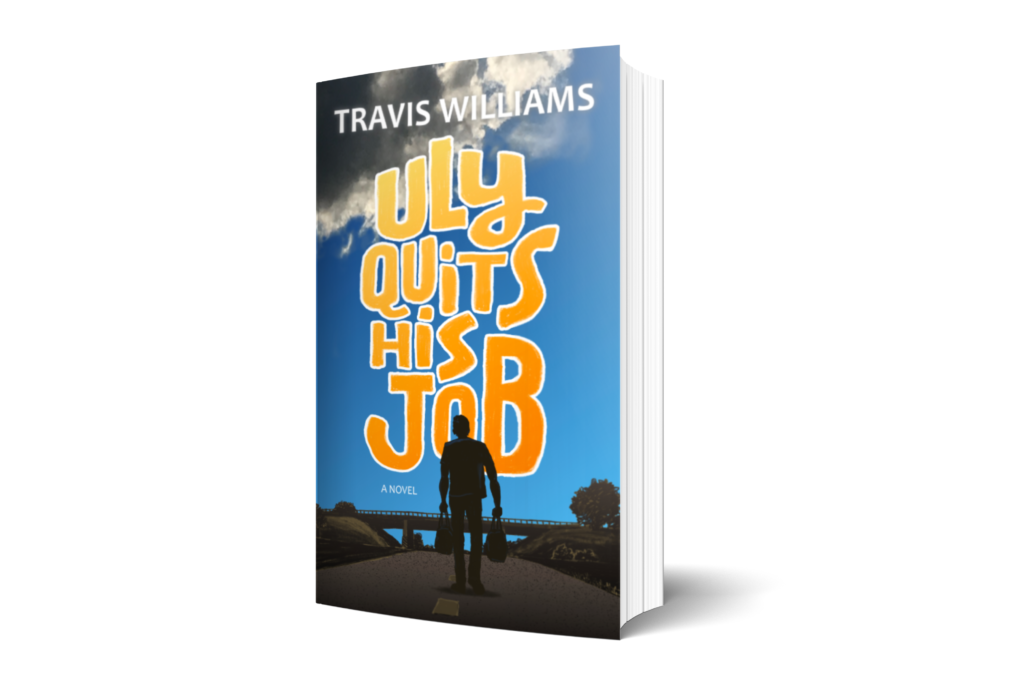
That said, I hope anyone who buys Uly Quits His Job in the hardcover format enjoys it as much as I have.
Travis
Travis Williams earns sales commissions from qualifying purchases made by following links on this webpage to Apple Books and Amazon.

by Travis Williams | Apr 19, 2022 | News & Updates, Banner Posts
Go forth with your ideas. Be productive. Make more pies.
My friends at Siretona Creative recently mentioned the Slicing Pie company to me. They have a software product that allows business partners to efficiently manage shared dynamic equity in a startup with multiple stakeholders. This idea seemed to have merit to me.
But it’s interesting to reflect on the economic metaphor of the sliced pie
There is no pie of fixed resources that is being sliced into tinier and tinier slices in the market by increasing demand and increasing populations.
At some point you were probably exposed to the idea that the more people there are the thinner we have to slice the pie of finite resources to provide for everyone. That’s not a logical sentiment, however, because people are creative, not dead weight.
However, your slice of the finite resource pie doesn’t have to be forever shrinking thereby decreasing your opportunities. Instead, abundance and prosperity grows when two interdependent dynamics are set free.
These two dynamics:
1) Division of labor, and
2) Freedom of association.
Set ’em free.
First, increasing division of labor is accomplished by increasing population.
Yep, even immigrants. Even illegal immigrants.
Larger, growing populations divide labor so that individuals specialize with greater and greater specificity according to their own choices increasing the quality and quantity of the output of their labor.
The key there is “according to their own choices.”
Division of labor doesn’t divide the pie into smaller units, it provides the people needed to create more pies that didn’t exist before.
People are creative, not dead weight.
It’s legitimate and even honorable to fight against population controls as well as war and tyranny.
Also, don’t try to do everything yourself. Delegate, network, collaborate. Share the burden, share the joy, share the income, and share the victory.
Greed is counterproductive and leads to shrinking pie pieces.
Second, freedom of association allows division of labor to exist. A society that values greater freedom of association leads to individuals interacting with one another in their own self-interest in ways that are win-win for everyone.
For instance, the value a reader places on acquiring a book to read is greater than the value they place on the money they part with to get the book. This is a win-win transaction for both the author and the reader in the free market.
Another example is in the labor market. People who work to provide labor and those who pay for that labor find each other and engage in an employee-employer or contractor-consultant relationship that is an expression of freedom of association.
If it’s not win-win, they have the freedom to part ways.
In society, there is nothing but individuals.
Individuals may choose to act in harmony, but it’s an error to anthropomorphize the collective. Governments, corporations, even families, are collections of individuals having agency and responsibility.
If individuals in a society are free, then people have the liberty to make purchases, live where they choose, read or write and publish what they want, take jobs or hire workers or do anything else. There is no Marxist exploitation of workers in a society that values freedom of association. The opposite is true. Socialism leads to statist coercion, undervaluing individual freedom and, ultimately, the cooking of fewer pies.
Individuals enjoy liberty if they are unencumbered by bureaucracy, central planning of the economy, and geopolitical barriers. Capricious legal restrictions, entrepreneurship licensing, and arbitrary law enforcement, are antithetical to liberty.
Furthermore, travel restrictions, lockdowns, fees, taxes, censorship, compulsory standards, mandates, regulatory compliance, coercion, enforcement, conscription, or anything else that limits individuals stopping them from pursuing their own choices decreases individual freedom of association.
It’s not just governments that encumber freedoms.
There is also a problem when the individuals who have government power—or who have benefited from it—sit idly by allowing others to keep us from acting in ways that are in our individual self-interest.
Finally, markets scale up or down in a way that is fractal—small parts look a lot like the bigger picture. This is the key to shared success and prosperity. Within a market, abundance increases for each individual who chooses to act. The pie doesn’t shrink.
People aren’t mere consumers. They are also creative producers.
Increasing prosperity is enjoyed by each person who chooses to engage in the economy with their own influence and in that way participate in the division of labor. The pie grows each time a person engages their freedom to associate in the market with whomever they choose in whatever way they choose.
Whole countries can grow in a free market environment, or you can experience the extraordinary power of a free market individually. Even if only one person chooses to act in a way that takes these concepts seriously, that person will benefit.
That means you. Go make more pies.
Travis
Travis Williams earns sales commissions from qualifying purchases made by following links on this webpage to Apple, Barnes & Noble, and Amazon.com.

by Travis Williams | Apr 16, 2022 | Banner Posts
This is most of the first email I send from my list
When you sign up to receive updates from me, this is what you start with.
I spent four years writing Uly Quits His Job (his name is pronounced “YOO-lee”). I also designed the cover.
I live in Georgia a two-hour drive south of Atlanta. I was born in Alabama. Growing up, we had dogs and cats. I had a special Sheltie named Rocky. I love dogs, but they aren’t allowed under the current feline regime. Two cats have me well-trained.
A while back I missed the first day of a week-long online course on marketing for authors. We knew each other but the facilitator didn’t. She asked the authors to take turns introducing each other to her.
Nicola MacCameron, author of the “Leoshine” science fiction series, chose to introduce me. Though I wasn’t there, I watched the recording later.
When she introduced me, Nicola mentioned the work I did on Stealth, a WW2 historical novel by our mutual friend, Robert Stermscheg.
Here is some of what She said.
“I will pick Travis because he is such a collaborator with me. He lives in Georgia and he’s written Uly Quits His Job, which is Southern fiction, which is its own genre and has its own cultural markers.
“He is a graphic designer and has designed a fantasy alphabet for me for my book. It’s just absolutely stunning. He’s very creative. He’s done book covers … He has influenced every book cover that Siretona has produced since last summer. He has an amazing eye for detail and he copy edits as well. Doesn’t he?”
The remainder of this note is available as the first email I send when you join the list to receive updates.
Travis